

Have you ever noticed how differently people experience life? Some are always full of ideas and energy, while others stay calm and steady no matter what happens. Some people can eat anything without gaining weight, while others struggle with even small changes in diet.
According to Ayurveda, these differences are not random—they are guided by your Prakruti, your unique mind-body constitution.
Your Prakruti is like your personal blueprint. It explains how your body works, how your mind reacts, and what helps you stay balanced. This concept is deeply rooted in classical texts like the Charaka Samhita, where it is described as something formed at the time of conception and carried throughout life.
When you understand your Prakruti, you stop guessing what’s good for you—and start living in alignment with your natural self.
What is Prakruti?
Prakruti refers to your natural constitution, shaped by the balance of three energies called doshas Vata, Pitta, and Kapha. These doshas influence everything from your digestion and metabolism to your emotions and behavior. While everyone has all three, one or two are usually dominant, creating your unique nature.
But an important question arises—how is this Prakruti actually formed?
“शुक्रशोणितसंयोगे यो भवेद् दोष उत्कटः।
प्रकृतिः जायते तेन तस्य नान्यथा भवेत्॥”
In Ayurveda, Prakruti is established at the very moment of conception. According to the Charaka Samhita, the union of the male and female reproductive elements plays a central role in determining the constitution of the child. The balance of doshas in both the mother and the father at that time directly influences the baby’s Prakruti.
This means that the physical health, mental state, and doshic balance of both parents contribute to shaping the child’s natural tendencies. If one dosha is dominant in either parent during conception, those qualities may be more strongly expressed in the child.
Ayurveda also places great importance on the mother’s condition during pregnancy. Her diet, emotional well-being, lifestyle, and environment all play a vital role in supporting the development of the baby. A calm, nourished, and balanced state in the mother helps create a more stable constitution, while stress or imbalance may influence the developing doshas.
These ideas are also supported in texts like the Ashtanga Hridaya, which highlight that both physical and emotional factors during pregnancy shape the individual.
In simple terms:
Your parents provide the foundation, and the womb provides the environment.
Think of it like a seed. The parents provide the seed, and the mother’s womb is the soil. The quality of both determines how the plant begins its life.
Once formed, your Prakruti becomes your natural baseline. It does not change, but your daily habits can either support it or disturb its balance.
Key Factors That Shape Your Prakruti
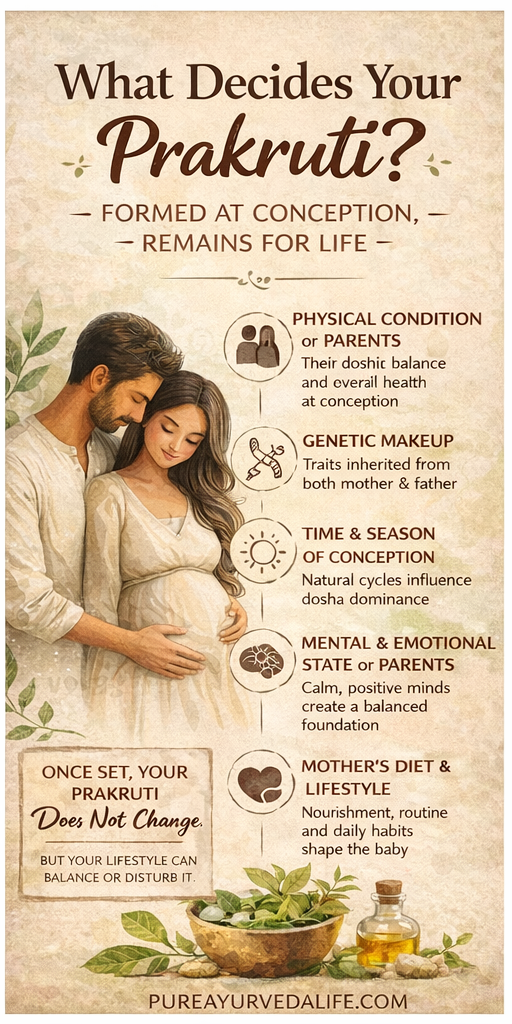
1. Physical Condition of Parents
The health and doshic balance of both parents at the time of conception play a crucial role. A balanced state supports a more stable constitution in the child.
2. Genetic Makeup
Your inherited traits from both parents influence your physical structure, tendencies, and natural strengths.
3. Time and Season of Conception
Ayurveda believes that natural cycles—such as seasons and time—affect dosha dominance, which can influence the constitution of the baby.
4. Mental & Emotional State of Parents
The emotional well-being of both parents at conception has a deep impact. Calmness and positivity support balance, while stress may influence doshic imbalance.
5. Mother’s Diet & Lifestyle During Pregnancy
The mother’s nutrition, daily routine, and lifestyle directly nourish and shape the developing baby.
6. Mother’s Mental Health
A peaceful and emotionally stable environment during pregnancy plays a vital role in creating a balanced Prakruti.
However, your daily habits, diet, and lifestyle can either maintain balance or create imbalance (Vikruti).
The Three Primary Prakritis
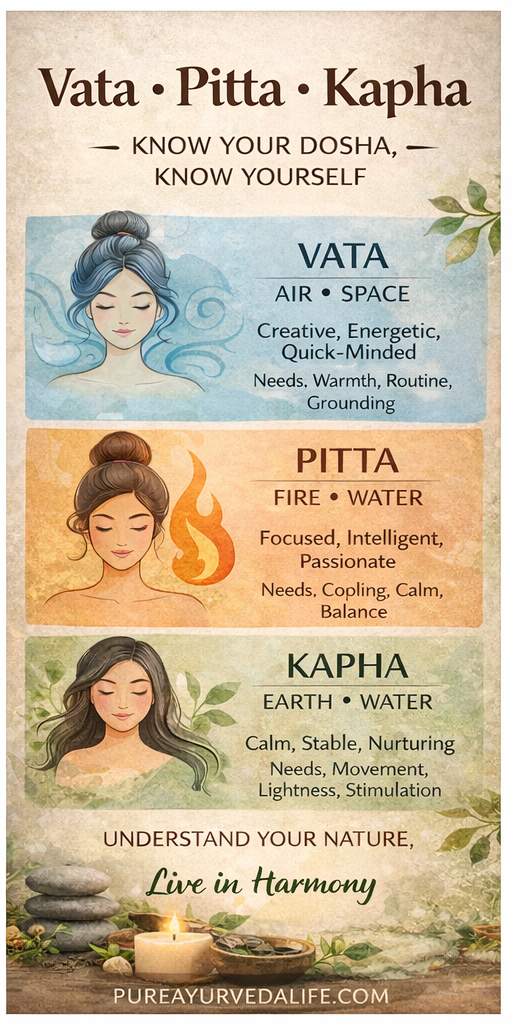
Ayurveda identifies three primary doshas—Vata, Pitta, and Kapha—which combine in various ways to form each person’s Prakruti. Each dosha represents a set of qualities and tendencies that can be observed physically, mentally, and emotionally.
Vata Prakruti: The Energy of Movement
Vata is associated with air and space, which makes it light, mobile, and constantly changing. People with Vata dominance often feel this movement both in their body and mind.
They usually have a lean body, dry skin, and may feel cold easily. Their energy is not constant—it comes in bursts. One moment they feel highly active and creative, and the next they may feel tired or overwhelmed.
Mentally, Vata individuals are imaginative and quick learners. They love new ideas and experiences, but they can also struggle with overthinking and anxiety when out of balance.
Common signs of Vata imbalance include:
- Anxiety or restlessness
- Dry skin and fatigue
- Irregular digestion
To stay balanced, Vata needs grounding and consistency.
Helpful habits for Vata:
- Eat warm, cooked meals regularly
- Follow a consistent daily routine
- Practice calming activities like meditation
When balanced, Vata brings creativity, energy, and inspiration.
Pitta Prakruti: The Energy of Transformation
Pitta is made of fire and water, giving it qualities of heat, intensity, and focus. It governs digestion, metabolism, and sharp thinking.
People with Pitta dominance often have a medium build and strong digestion. They usually feel hungry on time and may become irritated if they skip meals. Their body tends to be warm, and they may sweat more easily.
On a mental level, Pitta individuals are driven, focused, and natural leaders. They like structure, planning, and achieving goals. However, when out of balance, this intensity can turn into frustration, anger, or burnout.
Common signs of Pitta imbalance:
- Irritability or anger
- Acidity or heartburn
- Excessive heat in the body
Balancing Pitta is about cooling and calming both body and mind, as emphasized in texts like the Ashtanga Hridaya.
- Helpful habits for Pitta:
- Avoid overly spicy and fried foods
- Stay in cool, calm environments
- Practice relaxation and stress management
When balanced, Pitta expresses confidence, clarity, and strong leadership.
Kapha Prakruti: The Energy of Stability
Kapha is formed from earth and water, making it heavy, stable, and grounding. It provides structure, strength, and emotional balance.
Kapha individuals often have a strong, well-built body and tend to gain weight more easily. Their skin is soft and smooth, and their energy is steady rather than fluctuating.
Emotionally, they are calm, patient, and deeply supportive. They are often the “rock” for others. However, when Kapha becomes imbalanced, it can lead to sluggishness, low motivation, and resistance to change.
Common signs of Kapha imbalance:
- Weight gain or heaviness
- Low energy or laziness
- Feeling stuck or unmotivated
Kapha needs movement and stimulation to stay balanced.
- Helpful habits for Kapha:
- Stay physically active
- Eat light and warm foods
- Try new activities regularly
When balanced, Kapha brings strength, stability, and emotional warmth.
Dual Prakruti: A Unique Combination
Most people are not purely one dosha. You may be a combination like Vata-Pitta or Pitta-Kapha, which gives you traits from both.
Understanding your dual Prakruti helps you make more personalized and effective lifestyle choices.
Balanced Constitution (Sama Prakriti)
सर्वगुणसमुदितास्तुसमधातवः|
In Ayurveda, the ideal state of health is called Sama Prakriti, where the doshas (Vata, Pitta, Kapha) and body tissues are balanced. A person with balanced doshas exhibits qualities of all three. Individuals with Sama Prakriti typically have strong immunity, stable emotions, good digestion, and balanced energy. Ayurveda teaches that health is not about perfection, but about achieving and maintaining this natural balance.
What Prakruti Decides About You
Your Prakruti influences far more than just your personality. It shapes the way your body digests food, responds to stress, reacts to physical activity, and even fights illness. For instance:
- It determines your dietary requirements and which foods best nourish your body.
- It shapes your mental tendencies, including anger, fear, or joy.
- It governs your behavior, likes and dislikes, and natural preferences.
- It influences your physical attributes, stamina, and metabolism.
- It indicates which diseases you are more prone to.
- It guides how your body responds to treatments or medications, making Ayurveda highly personalized.
Knowing your Prakruti helps remove guilt from your natural inclinations. If you dislike certain foods, feel more anxious, or tend to overthink, these traits are not flaws—they are expressions of your unique constitution. Once you understand these traits, lifestyle and diet adjustments can help maintain balance, prevent illness, and preserve long-term health.
Modern Life vs. Your Natural Balance
In today’s fast-paced world, many people unknowingly live against their natural constitution. Vata individuals may skip meals and overwork, leading to anxiety. Pitta individuals may push themselves too hard, leading to stress and burnout. Kapha individuals may become inactive, leading to weight gain and low energy.
The key to health is simple—align your lifestyle with your Prakruti instead of fighting against it.
Final Thoughts: Your Body Knows Best
Your Prakruti is a blueprint of your mind and body, a guide that helps you understand yourself more deeply. While genes and environment play roles in your health, Prakruti explains why certain traits, behaviors, and susceptibilities are naturally yours. By aligning your lifestyle, diet, and habits with your constitution, you can achieve balance, prevent illness, and nurture your body and mind over a lifetime.
Remember, Ayurveda is personalized medicine, and no two people require the same remedies or routines. Understanding your Prakruti is the first step to living in harmony with your natural self, making health and vitality a lifelong journey rather than a short-term goal.
Ready to Discover Your Prakruti?
Start by observing your body, your habits, and your patterns. Awareness is the first step toward healing. Your journey to balance begins with understanding yourself.


Leave a Reply